Password:

Recent Posts
Search Site:
Entries from June 1, 2011 - June 30, 2011
Adapting To The Elements
 Thursday, June 2, 2011 at 4:27PM
 We can’t control Nature but we can learn from it. The last couple years have posed some real challenges for Northern Californian farmers, especially those who grow wine grapes. The extremely cool growing seasons of the past two vintages made it difficult to fully ripen the fruit before the potentially damaging fall rains came down. I wrote in more detail about the difficulties we faced in 2009 and 2010 and I’ll summarize by saying that coupled with the early onset and unusual heaviness of the rain, the seasons created a difficult choice for farmers: Either harvest the grapes before they are fully ripened to avoid the mold issues and dilution of the fruit that the rain could bring, or hope that the rain is brief so the ground dries and the grapes finish maturing. We like to say that these are winemaker’s years, when the great winemakers stand out. At Deerfield, we approached the vintage by making wines like those from regions of the world that never get too warm, like Bordeaux and Mosel Valley, and sorted our fruit even more meticulously than usual, sorting out moldy grapes caused by the rain. For a skilled winemaker, there need not be a bad vintage and ’09 and ’10 is proof of that, with outstanding wines like our 2009 Los Chamizal Chardonnay.
Well, we’re having another unusually cool spring and it doesn’t yet have the appearance of warming up, with the weather forecasting another week of rain for the beginning of June. The farmers of wine grapes in Sonoma County are quick to adapt however, seeing a recurring pattern. Last year in an attempt to help ripen the grapes almost everyone in the Sonoma Valley dropped some of their fruit from the vine, meaning they cut off bunches of grapes that were good, curtailing the yield of each plant and thereby channeling the vines’ nutrients and energy into the remaining clusters. This year, some farmers I’ve spoken to, like Dan Sanchez of Alpicella Vineyard, where we get our amazing Sangiovese grapes, say they’re taking a more proactive approach by removing formative grape clusters and reducing the yield before they even begin to flower. That way the remaining bunches get the attention of the vine from the very beginning.
The current weather is helping growers make informed decisions about how to approach the upcoming vintage. It also has more immediate impacts. In this episode of Cellar Rat TV produced before the last harvest, I talked about how our vines were fortunately protected from the late spring rains. People often ask what the effect all this rain is having on the vines. Water always means that you could have a mold or mildew problem, which you can treat organically by spraying the vines with sulfur. The more serious threat is that the rain can damage the fruit set by hurting the nascent flowers, either destroying them or washing away the pollen. The result is loose bunches where only a few of the flowers were able to become grapes, potentially diminishing the crop’s yield. On the positive side, the increased rain means the water is going deeper into the soil and lasting longer. This causes greater and deeper root growth, which will produce a more vigorous vine the following year and therefore a bigger crop.
The wine-growing region of Northern California has incredibly diverse climates, even in small geographical areas. While the rains might have affected some of our neighbors in the Sonoma Valley where it is a little warmer and the budding out therefore earlier, our vines are always a bit behind in the growth cycle, probably due to the Kenwood Marsh keeping the ground cool (I’ve noticed the closer to the pond you get, the less developed the vines are). Our vines haven’t yet flowered and the bunches are still protected by the little green pods called the calyptra, so I don’t expect the rain will have any other impact other than to make our vines grow vigorously throughout summer and perhaps provide a bigger crop next year. Since the spring was cool and wet, we look forward to a long warm summer and late fall rains.
How Clean Wine Is Made
Wednesday, June 15, 2011 at 11:03AM Deerfield Ranch Winery focuses on what we call “clean” wine. Clean wine is low in both sulfites and the histamines that are created by the yeast. What this means to you is that you can enjoy Deerfield wines without the fear of the dreaded red wine headache or a sulfite hangover the next day. You can read more about it here, but the gist is that the yeast produces histamines to protect themselves when they encounter toxins in the fermentation process. We make sure the yeast only find what their looking for when doing their job in the fermentation tank by feeding them a healthy diet, sorting our grape three times to ensure only beautiful fruit is present, and by maintaining rigorous sanitation procedures.
We have our own water treatment facility we recycle 98% of all water that we use. You take a tour of the facility with the winemaker on Cellar Rat TV. In conjunction with our own well, we’ve created a model for what a sustainable winery can be. We recently added a state-of-the-art ultra violet light sanitation system that completely sterilizes all of the water at Deerfield without the need to use any chemicals. The system passes the water through three ultra violet light chambers that irradiate the water in a continuous flow with ultra-violet light (trust me, NOT a bad thing) so that no microbes come out the other end. We’re thrilled to add this to the winery because it guarantees us that the water we use in the winemaking process is completely pure.
Making clean wine isn’t just about one thing though. It requires a concentrated and thoughtful effort at every stage of the winemaking process, from the vineyard to the bottling truck. It’s worth the effort though. I personally am terribly affected by sulfites in wine. We use sensitive equipment to gauge exactly how much oxygen is dissolved in the wine and then add only enough SO2 to seek out and bond with the oxygen, leaving behind only inert SO3. Often when our wines are first release the SO2 is lower than 10 parts per million which is below the human threshold. That number even decreases as the wines age. For those people (like the winemaker’s wife, PJ) who suffer from headaches that make drinking red wine an awful prospect, Deerfield offers a delicious revelation. If you are one of those people, go ahead, try a glass of Deerfield! You won’t be the first person to discover that you can enjoy red wine again.
Corkscrew Showdown
Friday, June 24, 2011 at 3:08PM It takes a lot of work to get wine into the bottle and sometimes it takes a lot of work to get it back out! Not everyone in the wine industry knows what it takes to make wine, yet everybody seems to have an opinion on the ubiquitous companion of the wine bottle: the corkscrew. Unlike beer bottles, which can be opened by all manner of party tricks, wine bottles require a bit of gadgetry to free the genie (although if you are caught in a tight spot here’s a clever way to open a wine bottle using only a shoe). They come in all shapes and sizes and everyone seems to have their favorite, so I thought I’d weigh in on the long running debate of which is the best corkscrew.
I’m sure that as soon as the cork was invented, people around the world began to devise methods to remove it. In fact so many wonderfully diverse solutions have been developed that there seems to be as many different types of corkscrews as there are wines. I’ve tried to break them down into a couple categories that they fall into:
Heavy Machinery – Anything with a mount falls into this category. Usually these attach to a countertop or wall but sometimes they have their own base to sit on a table top. These typically use a lever design where all you need to do is place the neck under the corkscrew and pull the lever down and then back up and voila!
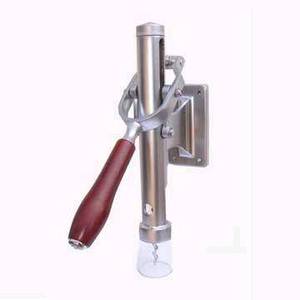
Cellar Rat Opinion Poll: Obviously the lack of portability kicks them out of the running for top pick but their smooth action is very nice when they’re around. They’re especially useful when you need to open lots of bottles at a bar. I particularly like ones that eject the cork like a shotgun cartridge!
“Houdini” Style Lever Operation – These guys operate using the same mechanism as the Heavy Machinery except that instead of mounting they have arms that grip the bottle. The lever automatically spins the screw into the cork as the handle is pushed down.
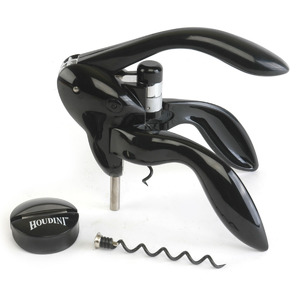
Cellar Rat Opinion Poll: I don’t like these at all. They typically offer some smooth operation but they don’t fit in your pocket and are kind of bulky, though companies are beginning to offer some more refined models. Usually they don’t come with foil cutters attached so even though you’ve got this bulky thing, you’ve got to keep track of another gadget.
Double Lever Corkscrew – These are the ones that look kind of like a woman wearing a dress. You place the corkscrew over the neck of the bottle then hand twist the screw which lifts the levers. Pulling down both levers gives you double the leverage for an easy pull.
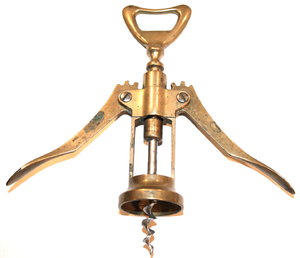
Cellar Rat Opinion Poll: These are by far my least favorite style and it seems like the idea has been rethought because I’m starting to see them less and less. I’ve never seen a wine professional use one of these on the job. They’re awkward because the arms lift as you screw so you can’t really hold the corkscrew to begin the operation.
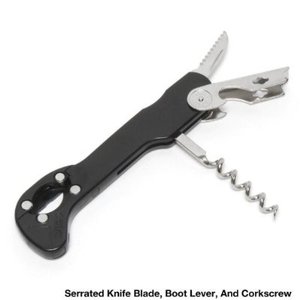
The Classic Waiter’s Corkscrew – The quintessential corkscrew. These Swiss Army Knife-like openers fold up to fit in your pocket and almost always have a foil cutter attached. They vary dramatically in quality and ease of use. Some are much better than others and the type of foil cutter also differs depending on the model.
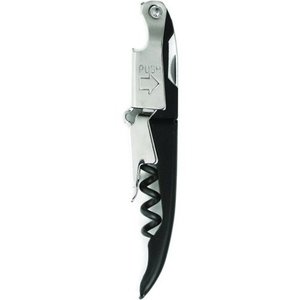
Cellar Rat Opinion Poll: Hands down, a great waiter’s corkscrew is a Cellar Rat’s best friend. Pick carefully though because it’s the subtleties here that make the difference. Quality is key. I’ve had the screw snap off before in the line of duty, which is always embarrassing. I like serrated cutters much more that non-serrated. Also there have been some innovations that have really changed the game. Nowadays, most waiter’s corkscrews have what’s known as a “2-step” operation. This means they have a second notch to gain purchase with so that you don’t have to work as hard to get it started. So far I’ve seen two designs: A hinged approach which I DO NOT recommend as they have the tendency to wear out and to bend inward. I recommend the 2-step that is actually made out of two separate pieces. My favorite is the Metrokane Rabbit Zippity. Funny name but it’s got everything: High quality, durable make? Check. Serrated blade? Check. 2-step, non-hinge lever. Check. Slim and sleek design. Check.
Boomerang Corkscrew – Similar to the waiter’s corkscrew design but they usually don’t have 2-step operation. Instead they feature a moving pivot point to improve the leverage. They are distinctive in that they feature a foil cutter that uses four little discs instead of knife.
Cellar Rat Opinion Poll: While I still prefer the waiter’s version, there are some nice perks to this type of corkscrew. The disc foil cutter is much safer and easier to use than the knife which takes a little technique and practice. I’ve seen many a veteran cut themselves with a knife when moving too fast. Also if you’re trying to get a perfect edge it seems like this type of cutter yields results everytime. If you’re looking for safety (maybe you’ve got kids around) this might be a better choice for you.
Miscellaneous – You might remember those weird corkscrews that aren’t corkscrews at all, but instead have two prongs - low tech and tricky, yet effective. Now they also have electric ones that do all the work for you with the press of a button. I’m sure there are many more unconventional approaches yet to be discovered.
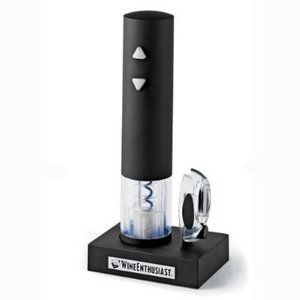
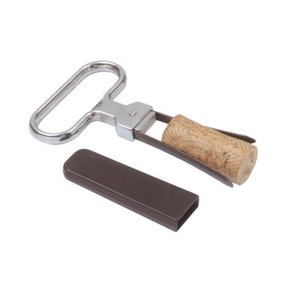
Cellar Rat Opinion Poll: There are some pretty nifty and quirky openers out there but I’d rather have my trusty Zippity than a conversation piece. Until the next great thing comes out I’m relying on my waiter’s corkscrew to get the job done.
The waiter’s corkscrew may be my favorite but I’ll admit that it can require a little finesse. Here's a few tips to use one safely and effectively:
- Put the back of the cutter blade against your thumb and use your forefinger to firmly grip around the neck of the bottle.
- Angle the blade down towards the collar of the bottle (See my "Anatomy of the Bottle" post) and rotate the bottle while applying firm pressure.
- Hold the point of the screw along your extended index finger to precisely guide the point into the cork slightly off center. This way when you begin to twist the screw in it will be centered.
- If you have a 2-step corkscrew make use of the double step! Start with the notch closest to the fulcrum and then move to the one on the end.
- When the cork pops, expect the sudden release tension so that you don't spill the wine by jerking the bottle.
Now you're ready to open bottles like a pro!
tagged corkscrews, how to
corkscrews, how to 
This work is licensed under a Creative Commons License. Copyright © 2006, The Cellar Rat. All rights reserved.
