tagged  rose, winemaking
rose, winemaking 
 Tuesday, March 8, 2011 at 11:51AM
  Sometimes it seems like the world of wine has had a line drawn in the sand. On one side there are fruity and light white wines and on the other side there are the structured and more tannic reds. But occupying the no-mans-land between these two different worlds is Rosé. Neither a true white or a true red, this pink juice shares characteristics of both.
All red wines draw their color from the skins of the grape and in this sense Rosés are no different. There are several different techniques that winemakers use to achieve the distinctive style of Rosé. Sutter Home's technique which it uses to produce their um...ubiquitous...*ahem* White Zinfandel is the product of a winery accident where red wine was accidentally added to a white wine tank and to this day, most of the Rosés on the market are produced by simply blending red and white wines. Alternatively, when the winemaker’s intent is to produce a Rosé from the beginning, grapes are harvested at very low Brix to achieve a light wine with low alcohol. Unlike red wines that are fermented along with their skins throughout the entire process of primary fermentation, Rosés are only briefly in contact with their skins before they are pressed, often only for as short a period as a few hours.
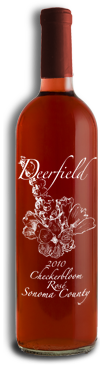
Deerfield uses a traditional approach to making Rosé. Deerfield produced a Rosé in 2009 and our latest one, the 2010 Checkerbloom Rosé, was just released this past week. Deerfield uses a traditional process known as Saignée (which means "bleeding off") to make our Rosé. In this process grapes that are picked at a high Brix, which have too much sugar that will likely produce a wine with too high alcohol yet beautiful ripe fruit flavors, are macerated and some of the juice is "bled off" to reduce the skin to must ratio. This extra juice is ideal for creating a Rosé. Rosé can be made out of many different varietals or a blend. The juice we use to produce our Rosé was bled off of our 95 point Old Vine Zinfandel which invariably is harvested at high Brix. Already colored by its contact with the skins, we treat the juice quite differently than either a normal red or white fermentation. We ferment at a low temperature to slow the process, and in neutral oak barrels which is typically a treatment we reserve for Chardonnay. The barrel fermentation develops softer tannins and lengthens the mouthfeel. Even though this wine is fermented without its skins like a white wine, we use a strain of red wine yeast that is known to accentuate the fruit character. This is what makes our Rosé stand out - it has bold fruit flavors and body, yet it is light and approachable.
rose, winemaking Friday, March 25, 2011 at 3:49PM ;) Molecular Structure Of TanninThere are a few essential elements in the composition of wine that define it. Among those elements is tannin. Without tannins, wine just wouldn’t be wine. Understanding a little bit about what tannins are allows you to better understand the marvelous sensation you experience when you have a sip of wine. A unique and complex combination of compounds, tannin isn’t so much a particular taste as it is sensation. A good way to think about it is that along with the acids, tannins are the structure of the wine and the particular flavor nuances sit on top of that structure. It’s the shape of the wine.
Molecular Structure Of TanninThere are a few essential elements in the composition of wine that define it. Among those elements is tannin. Without tannins, wine just wouldn’t be wine. Understanding a little bit about what tannins are allows you to better understand the marvelous sensation you experience when you have a sip of wine. A unique and complex combination of compounds, tannin isn’t so much a particular taste as it is sensation. A good way to think about it is that along with the acids, tannins are the structure of the wine and the particular flavor nuances sit on top of that structure. It’s the shape of the wine.
It’s a tricky concept to translate to words. We’re visual creatures and humans have developed a huge vocabulary to communicate to one another things we see. But there wasn’t a word for red, how would you describe it to someone else? …or to someone who’s never seen it? That’s the challenge of describing the sensation of taste: There simply isn’t a vocabulary that belongs to it. Wine drinking is a social experience, however, and enthusiasts yearn to share it with others so have borrowed from the visual realm to describe the incorporeal attributes of taste. Often shapes are used to describe the sensation of tannin: rounded, edgy, linear or pointy are things you might hear.
Tannins can be found all over. In fact, tannins are an integral part of all fruit flavor. The seed of every fruit has tannin. You might notice it when you suck on a cherry or peach pit. Grapes however have unique tannins that offer a distinct experience from tannins found in other fruits. Almost all cream of tartar found on the market today is made using tannins extracted from grapes. Though you don’t analyze the sensation of biting into an apple as critically as you might sipping wine, you would certainly notice and miss the tannin if it was gone.
Fruit isn’t the only place that we find tannin however. A vital reason that oak shares such an affinity with grape juice is that its own native tannins serve to compliment or contrast with the tannin found in grapes. All wood has tannin in it. Cherry and redwood both have very soft tannins and though they are nowhere near as heavily used in winemaking as oak is, they lend their tannins to wine with favorable results. Even within the oak family, the different species of oak tree (French, American and Slavonian) have distinctive tannin structures of their own. Oak tannins tend to be more “edgy” or “rectilinear”, and it’s this contrast to the more rounded tannins found in grape skins that can create complexity. The cooperage (barrel maker) can redefine the nature of the oak tannin by the manufacturing process. By toasting the barrel at cooler temperatures and by air drying it for longer periods of time, the cooper can round the corners of the tannins producing an oak that is more complimentary instead.
Clearly there’s a great deal of diversity of tannins out there. Every cluster of grapes contains several different types of tannin. The tannin in the stems, skins and seeds are all very different and while it’s generally agreed upon that the tannins found in the stem are too harsh and not ideal to include in the fermentation, there is debate about the quality and character of tannins found in the seed and skin. The prevailing opinion has been that seed tannins are harsher than skin tannins and therefore ought to be removed. Robert Rex disagrees with this notion and instead believes the reverse is true, which is a view shared by Dr. Roger Boulton, professor at UC Davis. Robert’s reasoning is that we use a fairly uncommon process known as whole berry fermentation where the grapes are never crushed and instead the juice ferments inside the berry. The difference is that the skins are never ripped apart, releasing the harsh tannins found inside. Our wines have notably soft tannins even though they are fermented along with all their seeds. Robert concluded that the least common denominator must therefore be the skins. Seed tannins tend to add structure to the center of the palate while skin tannins slide toward the back.
Tannin can be described as a sort of drying effect and if you ever have had a sip of wine and felt as if it coated the roof of your mouth, it was because there was too much tannin. To remove tannin, winemakers often make use of fining agents. In California, gelatin is commonly used and in France egg whites are the norm. At Deerfield, because of our gentle production techniques, we very rarely need to make use of fining agents and for that reason we are able to make wine that is vegan friendly.
Even white wines have a small amount of tannin in them. Almost all of the tannins are found in the skin and seeds which are immediately removed by pressing before white wine is fermented. Although our high-tech presses the grapes extraordinarily gently, some of the tannin from the skin is squeezed out. Furthermore, alcohol is the most effective agent at extracting tannins from the other parts of the grape and because the skins and seeds are removed before the alcohol is present (since the juice has not yet fermented), there are fewer tannins found in white wine.
The truth is that even the experts are dealing with an imperfect picture of exactly how tannin interacts with our taste buds. In this article Dr. James Kennedy presents a number of different theories as to the exact cause of the perception of tannin in wine. What we do know is that tannins gain complexity over time. As the years go by, all sorts of different flavor and color compounds floating in suspension in the wine combine with the tannin giving rise to endless new iterations. That’s why wine changes so dramatically with the passage of time and can sometimes go through periods of awkwardness or exceptionality.
tannin, winemaking 
This work is licensed under a Creative Commons License. Copyright © 2006, The Cellar Rat. All rights reserved.
