Password:

Recent Posts
Search Site:
Entries from September 1, 2010 - September 30, 2010
Harvest 2010 Begins!
 Wednesday, September 1, 2010 at 3:04PM
 There is much to be done on the crush pad and in the cave before the first grapes show up. The new crew is almost completely assembled. There are some familiar faces and some new ones. Cecelia, the assistant winemaker, is in charge of hiring the crew and this year is definitely a cast of characters. Aaron and Cruz are the year-round cellar staff – they top the barrels, rack them and maintain the sleeping wines during the off-season. But harvest requires much more manpower so joining the team is a couple of veteran cellar rats including Dean, the San Diego surfer, and Ryan, our Texan talent, who has been working for us as Regional Sales Manager since the end of last harvest. Amanda, the lab technician, was due to depart to continue her studies but I suppose the allure of fermenting grapes was too much to resist because she came back to work the harvest. A new addition to the team is a fine young gentleman from Louisiana named Will, who, with his pleasing southern drawl, also brings a lifetime of farming experience. He knows the long hours that harvest requires, regardless of the crop. Even though there won’t be any fruit to crush for several weeks, the rat pack will have plenty of work to keep them busy. As I mentioned at the start of the 2009 harvest, the machinery required for the crush has been sitting idle for the better part of the year and must be sanitized and put in working order. In fact, the first order of business will be to clean the entire cave from top to bottom. Keeping the cave clean during harvest is a difficult task with the constant influx of sticky grapes so starting with a clean slate is crucial. It’s also an opportunity for the newbies to learn the ropes. I spent my first days topping barrels and racking wines which familiarized me with how to use most of the equipment and our sanitization protocols. Before we know it the first of the grapes will be rolling onto the crush pad from vineyards in hotter climates and Harvest 2010 will be underway. Our grapes greatly benefited from the heat last week and have been rapidly undergoing veraison, or the changing colors of the grapes from green to red. In a few of the rows exposed to the sun it’s almost at 90%. Though the grapes are ripening slowly this year, Robert tells me this can actually be a great benefit to the wines. Slow ripening leads to deep and complex flavors, but the trick will be to get them off of the vines before heavy fall rains.
The Grapes Ripen (Finally!)
Wednesday, September 8, 2010 at 10:36AM Though the grapes have been maturing slowly, the fruit hanging on the vines has almost completely turned red during the process called véraison. In other posts I’ve used the term véraison quite a bit and briefly explained its meaning but didn’t go into much detail. It is a borrowed French word meaning “the onset of ripening” and in English it is defined as the “change in the color of the grape berries”. Up until this point in the life cycle of the vine they have been expending their energy dividing and expanding the cells which form the grapes. The reddening of the grapes mark the moment that growth stops and ripening begins. The green turns to the familiar red hue of the grapes as chlorophyll breaks down and new pigment molecules such as anthocyanins are formed.
The acidity in the grapes begins to decrease as sugar accumulates. You may be familiar with the measurement Brix which is the percentage of sugar in the juice. Each week, the grapes will gain about 1.5ºBrix until they are fully ripened, usually at around 25ºBrix. Depending on the varietal, the winemaker may choose to harvest the fruit well before they become this sweet. Brix may rise further due to dehydration of the berry with no further sugar being produced.
This year I’ve really enjoyed watching the vines transform from little more than twigs into great leafy hedges. I’ve been eating the grapes throughout the growing season even when they were so sour they made my face pucker. It wasn’t until véraison occurred that they started to actually taste like grapes. The vines have a finite amount of energy available to produce the fruit. The trick is to channel that energy into producing high-quality, fully-ripened berries.
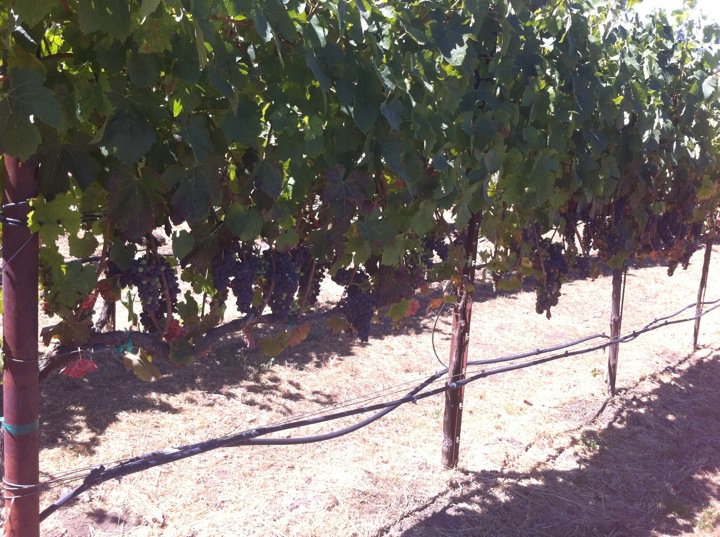
You hear the phrase “dropping fruit” a lot this time of year. It means removing clusters of grapes so that each vine has fewer bunches with the aim of producing more flavorful grapes. This is definitely something that distinguishes the wine industry from other agricultural industries: Growers get paid by yield, like every other farmer, but many are dedicated to quality and are willing to reduce yield to increase quality. At this point some of the clusters are lagging behind – while most of the bunches have reached 100% véraison, a few stragglers still have half of their green berries left. These bunches will never fully ripen and in the meantime just sap the energy out of the vine that could be used to ripen the other grapes. These green bunches will be cut off and sacrificed to help ripen the rest.
The crew is busy cleaning the winery in preparation for the incoming fruit but the harvest is so late this year that it’s likely they will finish well before the first grapes arrive. We’ll be using this downtime to send the crew into the vineyard to drop under ripe bunches and remove any grapes that raisined due to sun burn during the heat wave last week. Usually the grapes laid bare to the sun have a chance to tan, thus protecting them from sunburn. This year they never tanned. It was too cold. When the heat wave hit and temperatures got up to 105º these exposed berries got burned. Most of these bunches will be culled along with the green bunches.
No Sour Grapes Allowed
Wednesday, September 15, 2010 at 3:51PM Harvest has certainly been slow to arrive this year but soon the grapes will show up on the crush pad and begin their transformative journey. Part of what makes Deerfield wine so good is that we only use ingredients of the highest quality. So the first step is to sort the fruit - only perfectly ripe grapes make the cut. By the time the grapes arrive on the crush pad they have already been sorted once. In the vineyard, grapes that are fully ripe are the only ones that make it in the basket. But picking is huge job and workers, who often get paid per picking basket, don't always operate with as much scrutiny as we would like. For that reason once the grapes reach the winery they are sorted two more times by our crew.
The fruit is dumped from the half-ton bins that the grapes arrive in into a hopper which dumps them onto a conveyer belt and spreads the grapes out. At this point the grapes are still attached to their stems so we call this portion bunch sorting. We remove any leaves and clusters that are underripe or raisined. Sorters keep a constant vigil for any bunches that have any sign of mold or mildew. As the endless sea of grapes drift past, your eyes dart rapidly from bunch to bunch. Sometimes the signs of under ripeness are barely perceivable: The skins are a slightly different shade of red. Sometimes the only way to be sure is to taste them.
By the time the bunches of grapes reach the end of the sorting table and drop into the destemmer, only fully ripe grapes remain. The destemmer is a fairly simple machine. Paddles spin one direction and a cylinder with holes for the berries to fall through spins the other way. It's effectiveness varies, usually by the varietal. Zinfandel with its thick stems, for example, sometimes comes through the destemmer with no sign of any green at all. Just beautiful black pearls come out the other end. On the other hand Merlot's delicate stems often get chopped up and ejected along with the grapes.
The grapes then fall from the destemmer onto a "shaking table" which just a table with a grate that oscillates. It does an exemplary job of catching stems leaves and "shot berries" (tiny green grapes which were never pollinated). The shaking table was the bane of last harvest because it made a terrible racket. It was so loud that you couldn't hear the music that your headphones were playing. Halfway through harvest, Robert overheard a cellar rat grumbling about it and 30 minutes later, using only a wrench, silenced the machine.
The shaking table dumps the grapes onto a final sorting table. At this point the goal is to remove the MOG - industry slang for "matter/material other than grapes". If the yeast doesn't encounter any toxins during fermentation, the yeast will not need to produce histamines to protect themselves. Histamines are what cause red wine headaches. That is what we mean by clean wine and why Deerfield triple sorts our fruit, which is definitely not the industry standard. Mostly the focus is to remove anything green. The tiny stems that make it through the destemmer are often referred to as "jacks" because they look like jacks from the popular children's game of the same name. At the end of this sorting table all that remains is perfect, delicious grapes. We're anxiously awaiting the arrival of the first grapes! Harvest continues next week on DeerfieldCellarRat.com.
Punch It!
Thursday, September 23, 2010 at 4:25PM Last week we talked about how the grapes are sorted once they arrive on the crush pad. So what comes next? The sorted grapes are ready to be fermented at this point. We use two types of containers to ferment the fruit in, large stainless steel tanks and smaller plastic bins. Red wine goes through primary fermentation with the grape skins, which is where the vine gets its color. In fact, you can actually make a white wine from a red grape if the juice is immediately separated from the skins. Much of the tannin that gives red wine its structure is found in the skins so it is very important that the fermenting juice, or must, is in contact with the skins.
The skins float though, so they constantly rise to the surface forming a thick layer we call the cap. In order for the skins to fully transfer the flavor to the must, they must be re-submerged periodically, usually several times a day for the full duration of fermentation. This process is called a punchdown. You may have seen pictures of people on top of vats of grapes, holding themselves up while using their feet to push the skins down. Well we don't use our feet anymore but I guess the name stuck because the tool you use to punchdown the cap is called a foot. They come in many sizes and shapes but are usually just a rod with a flat surface with holes in it at one end. We've got several varieties of them here at Deerfield and I think everyone has their favorite one.
During crush we often have as many as 40 lots of wine fermenting at one time. Our protocol calls for each of these lots being punched down twice a day. So usually while the majority of the crew sorts fruit, one lone cellar rat goes from bin to bin punching down the skins. By the time you get done with the last one it is usually time to go back to the first one and start again. It's quite a work out. Sometimes it's as easy as pie but occasionally the cap is compacted and more than a foot thick. Perched precariously on the thin lip of the bin, wearing slippery galoshes, you throw your full weight onto the foot. Suddenly the cap gives way and you feel all resistance disappear. Falling into the delicate fermenting fruit is not an option so desperately you lean backward to regain your balance. Phew! Repeat another 40 times. The cap of the large stainless steel tanks is often too thick to punch down by hand so we use an alternate method which we call a pump-over that I'll go over next week.
tagged winemaking
winemaking 
This work is licensed under a Creative Commons License. Copyright © 2006, The Cellar Rat. All rights reserved.
