tagged  crew
crew
crew 
 Wednesday, September 2, 2009 at 9:55PM
 The reference in the article title to the crew is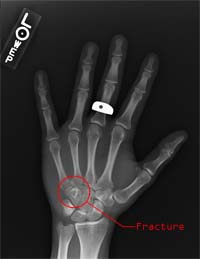 what you were thinking it is. The cast probably isn't. I broke my hand last Thursday falling off of my bicycle. Nothing glamorous - just a random accident. A pear was involved. I flew headfirst over the handle bars and managed to catch myself before my head hit the pavement. I saved my skull but I fractured the fifth metacarpal on my left hand. In case you're not sure where you might find a metacarpal, here's a picture:
So I went to the doctor and he put a large misshapen cast on my hand. Nowadays you can get a cast in the color of your choosing. When I mentioned I worked at a winery, the nurse told me that the color selection included Cabernet. I must be in Wine Country. They were able to leave three fingers sticking out of the cast, so now I've been reduced to one hand and one wine tinted claw. It's going to take at least four weeks to heal so I'll pretty much be a crippled rat for all of September. One problem is that I can't get my cast wet and, as you know by now, being drenched comes with the territory. So my dear mother found a solution: A latex arm-length mitten that vacuum seals onto your skin. It's like the Chiller - effective but ugly. The goofy thing is bright blue and when I wear it it looks like I ran into Dr. Frankenstein and he took it upon himself to replace my arm with that of a Smurf's (an obese Smurf that underwent a botched liposuction).
I could tell you how disspointed I am or how difficult it's going to be. But I'm not going to do that. I'm going to keep on working and do as much as I possibly can with a smile on my face. When I showed my cast to Robert he gruffly told me to pick up a bottle with my hurt hand. I picked it up with my claw hastily. "See," he said, "You'll be fine."
I'm not going to dwell on it. I'm just going to move on and eventually things will be back to normal. So let's do just that.
It occurred to me that what really makes the winery experience fun has a lot to do with the people you work with and insofar I haven't really provided you, the reader, with a sense of what the crew is like. They're all hard workers but they're also a bunch of characters. Right now my fingers feel like dumb bells and I need to get some rest, but tomorrow I'm going to break it down and describe everybody's stories and their idiosyncrasies. Stay tuned!
The Cellar Rat
Let me introduce you to the people that make Deerfield Ranch Winery run. These hard working people work together as a team to transform a mountain of grapes into an ocean of wine.
You've already met the star of the show. I've talked about Robert in other stories so you probably have a sense of who he is. But if you're a new reader, I'll tell you a little about the winemaker. He's incredibly knowlegeable and skilled in everything that relates to the craft of winemaking. He's surly and quick to smile, a wide sardonic grin framed by his handlebar mustache. He is constantly in motion. He never gets angry when people make mistakes, he just teaches them how to do things correctly. He is laid back, and that is amazing considering the stress of the harvest.
Robert's right hand man is actually a woman. Cecilia, the assistant winemaker, is a very wonderful, very short, and currently very pregnant Argentinian. She has an accent that makes her speech sound lyrical. She is pragmatic, organized, cautious and devoted absolutely to the process of making world class wine. I don't know if it's due to her pregnancy, but she is very maternal and always makes sure the crew is treated well. She's straightforward but not curt, and she is always kind. She's my boss and I am thrilled.
Amanda is our labratory technician. She can be seen walking to and fro with a beaker in her hands, conducting a variety of tests on the wines. She is smart and beautiful, and she narrowly avoids the aloofness that people of a high intelligence sometimes possess. She is a bit of a loner, I think, and her work suits her, but she's also always happy to jump on the bottling line or the sorting table. She cares deeply about Deerfield's wine and is a skilled attendant to the proccess.
The following people are part of my Cellar Rat pack:
Aron is the team leader. He has almost ten years experience as a Cellar Rat and he knows how to do his job. His English isn't perfect but he can appreciate a joke in any language. He loves to laugh but when it's time to work you better get serious or else Aron will give you a tongue lashing. When Cecilia isn't around, he's the man.
Cruz is another player for Team Mexico and also experienced in the trade. His offbeat sense of humour makes everything more fun. I started calling him "Dino" because of his penchant for sneaking up behind me and making a sound that's close to the creatures in Jurassic Park. He's very curious and calm. He and I have become good friends.
Manuel has the best english of our biligual staff, which is a good thing because he likes to teach. He always takes the time to break things down and show less experienced people the ropes. He has made his own wine in the past and while he sometimes has a different idea of the way things should be done, he is very knowlegeable about the science of winemaking. He also comes to work wearing nice dress shirts and at the end of the day, when I'm filthy from head to toe, Manuel inexplicably doesn't have a spot of wine on him.
Ryan is one of the new guys and already a fast friend. He is a true Texan that has fallen in love with California's Wine Country and decided to leave his home to follow his heart. He was a wine distributor in the Dallas area and I think he has a better knowlege of wine than the rest of the Rat Pack. This is his first harvest so he's putting all of the theory into practice and realizing how much you can't find in a book. His true passion for wine shows whenever he talks about it with his characteristic southern drawl. To his chagrin, I've taken to calling him "Tex" but he's a good sport about it.
Salvador is a Mexican American from Phoenix who speaks fluent Spanish. That has allowed him to become very effective because Aron is the one who knows what's going on and he communicates much better in his native tongue. Salvador has made wine at home in the past and loves learning how it's done right and being a part of the process. He's cerebral and observant with a sense of humour that defies description. He's eager to learn and slow to judge but most of all he's complex. It'll be fun getting to know him better.
One of the most interesting additions to the crew would have to be Marianna. She is a Bulgarian woman who speaks very little English and seems to have been transported in time and space from the Old World. She likes to be involved and do things herself. More than once she's snatched something out of my hands so that she could do it. She's never idle. Salvador works with her and takes pleasure in trying to learn the Bulgar's language.
Dean just started this past week and I don't really know him well yet. He seems like a very friendly and laid back kid with a real Santa Cruz air to him.
So maybe now you have a better picture of daily life at the winery and you'll be able to follow the adventure's of not just me but my fellow Rats. Will Salvador even learn Bulgarian? Will Ryan's romance with California culture continue? Will Manuel ever get his shirt dirty??? Find out next time on DeerfieldCellarRat.com
crew Saturday, September 5, 2009 at 11:30AM Ladies and gentleman, Harvest has arrived. The grapes arrived like the first rain of Fall: They showed up abruptly, without warning and aren't going away. Actually, the first grapes of Deerfield's 2009 vintage appeared on the crush pad in the middle of bottling. The crew split in two with one team manning the sorting table and the other team running a skeleton crew on the bottling line. It was very cool how everything had come full circle so that the very beginning and end of the winemaking process were happening concurrently, side by side.
Everyday since then we've been receiving literally tons of grapes and have been staying at the winery well into the evening to finish processing them. So far we've crushed about 12 tons of Pinot Noir and about 6 tons of Sauvignon Blanc. Depending on what kind of grapes we're crushing and what we are trying to do with them, the configuration of the crush setup changes. For example, red wines like Pinot are fermented initially with the grape skins so the process looked like this:
The grapes arrive in the large macro-bins described in "Bin City" and are placed one at a time in the tall dumping device. The dumper can be precisely controlled by a worker on the sorting table, who empties the grapes into the hopper at one end of the table at a speed comfortable for quality sorting. About four people man the sorting table, keeping constant vigil for any bunches of grapes that don't meet Deerfield's high standards. There are many criteria for acceptable grapes but some of the factors that cause us to toss the grapes include over or under ripeness, mold and raisining. Often the only way to tell whether a bunch is good or not is to taste it. I've never eaten so many grapes in my life! We throw away a sizeable percentage of grapes that we paid for. But it takes grapes of only the highest quality to make wine of the highest quality. Next the grapes fall into the destemmer, which does 90% of the job. The destemmed grapes then fall onto a shaking table which most of the seeds fall through. Lastly the grapes fall onto the berry sorting table where the remaining stems are removed along with any other dissatisfactory grapes that escaped the first sort. The grapes fall off the end of the line into another macrobin. Those in turn are dumped into a larger bin intended for fermentation instead of transport. Once full, the bin is placed in the cave where it awaits the inoculation of yeast to begin maceration.
But that's just one way to skin a cat. Sauvignon Blanc isn't fermented with its skins, so once the grapes have been sorted they go straight into the press. Because they won't be destemmed or furthur sorted it's important to weed out the unripe grapes the first time. The juice is pumped straight from the press to one of the large stainless steel fermentation tanks. The process of making white wine is really much easier.
Harvest is in full swing now and I've already started working 12 hour days. The crew is really starting to become a team and work together. Tempers are already flaring, and pressure is mounting. Harvest is a very dramatic time. Though the work is hard, it is fun to be part of such a dynamic process and everyone is clearly excited for what lies ahead.
Because of my hand I've been given a new job until it heals. Learn just what it is next time!
Monday, September 7, 2009 at 7:53PM There's definitely a distinction between working at a winery, helping to make wine, and making your very own concoction. So you can imagine my excitement when my fellow Cellar Rat Ari suggested that I collect the precious juice that was dripping from the bottom of the sorting table. Apparently the juice isn't of a high enough caliber to be used by Deerfield, but it's perfect for the experimentation of a fledgling winemaker. And so I happily filled up two empty water cooler jugs with the Sauvignon Blanc must (must is the industry term for unfermented juice). Robert explained to me that the jugs were referred to as carboids and Ari showed me a clever way of filtering all of the grape leaves and other junk out of them by siphoning more must in to force the waste out. I stowed my treasure in the safety of the cave and asked Robert what the next step was. He told me I should add bentonite and sulphur dioxide. He explained that the bentonite causes the sediment to settle on the bottom and makes the juice clear. Further research shows that, more specifically, it is capable of absorbing large amounts of protein. The SO2, as I explained earlier, scavenges the dissolved oxygen. For now, the wine is sitting quite still, waiting for the bentonite to to it's job. In a few days I'll rack it into another container and add the yeast to start fermentation.
I'm going to update this post as my wine continues its journey so check back here to see how it's progressing!
winemaking Tuesday, September 22, 2009 at 9:34PM Hello and welcome to DeerfieldCellarRat.com! If this is you're first visit then allow me to express my gratitude for checking out the site and I hope you enjoy reading. If you're a fan of the site then please accept my sincere apology for leaving you out of the loop for the last week or so. I know some of you are really enjoying following along with the harvest, but as you know it is in full swing by now and you can probably imagine that it has been very hard to find the time to write. But I'm back at the keyboard now so let me fill you in:
Last time I left you with a cliff hangar. Due to my debilitating injury and thanks to doctor's orders I had been reassigned from normal duty and asked to fill a different role. This is what happened: I reported to Robert that the doctor said I was to refrain from using my left hand as much as possible. Our laboratory technician was present at the time and unfortunately for her, Robert, doing some quick thinking, announced that she had a new assistant. Amanda and I glanced at each other, equally surprised at the verdict. I was pleased (as I always am at the prospect of learning something new). I can only guess her feelings about acquiring a new assistant. Truth be told, I have a pretty good idea about it because that was two weeks ago and she got rid of her meddlesome assistant pretty quickly. Ignoring doctor's orders, for better or for worse, I returned to my daily duties as a Cellar Rat, single-handedly conquering each task appointed to me, after only one day of shadowing her in the lab. In that time though I did get to learn how to test the wine for Total Acidity, pH, dissolved oxygen and free sulphur. Acidity is a crucial measurement because having the right amount of acid is critical for producing a balanced wine. I learned that pH is actually not a helpful measurement of acid as is just a buffer that compares the level of acid to the level of base. Dissolved oxygen is the amount of oxygen mixed into the liquid of the wine causing it to oxidize internally in a way. That's why we add the SO2. If you recall it bonds with the O2 to become the neutral SO4. Sometimes it does it's job and there's some left over. That's what the free sulphur test is for.
Even though I haven't been spending much time in the lab I have been spending a lot of time doing something that has a real chemistry feel to it. As you may already know, yeast is the crucial ingredient that transforms grape juice into wine. That amazing, rapidly multiplying, living organism, munches the sugar and produces alcohol. It occurs naturally in the vineyard and because it only takes one yeast cell to create a colony, grape juice left alone will eventually ferment, which is how, I imagine, they discovered wine in the first place. These days though we take a more advanced approach, selecting and adding species of yeast that accommodate specific species of grapes. In fact, we have cultivated yeast so much that we can use different kinds to produce specific flavors. The yeast have fairly unromantic names like "RC212" or "D47". Occasionally a charmer comes along like "Rhone 4700". The process of adding yeast to the juice is called inoculation. Care must be taken during this process because happy yeast makes good wine and if you don't make sure those microscopic buggers are having a good time, they'll make sure to spoil your dinner party. Before you add the yeast you add it's food. Superfood to be precise, a delicious mixture of nutrients and amino acids that prevents the yeast from becoming cannibalistic and consuming the carcasses of cadaverous comrades (please excuse my fit of alliteration). DAP, or diammonium phosphate to be exact, is also added to feed the hungry critters. At this stage tartaric acid is added not for the yeast, but if it is determined more acid is required to balance the flavor. The juice is now ready for the yeast to be added, but first the yeast must be awakened. You see, the yeast is in a dormant state and needs to be activated after it's long hibernation. So water is heated to the exact temperature it likes: 105 degrees Fahrenheit. A catalyst called Go Ferm is added to the water and then the yeast is slowly mixed in. It takes about 15 minutes for the yeast to wake up and after that period a sufficient amount of wine is added to acclimate the yeast to the temperature of the juice it is about to call home. The mixture of water, juice, Go Ferm and yeast turns a phenomenal shade of violet and is then evenly poured over the surface of the bin/tank. The punch down method is insufficient to properly mix the yeast with the wine so we use the pump over technique: With the use of an air pump, juice is sucked from the bottom of the bin and pumped over the top. After fifteen minutes the juice has everything it needsto begin fermenting. The Brix will drop every day from now on and the temperature will rise. Fermentation is an exothermic reaction and the temperature can get up to the low nineties. The reaction produces an incredible amount of CO2. After one to two weeks the juice will have, by definition if not taste, become wine.
Well I hope that this article makes a up for my absence. I promise, readers, another article tomorrow! I'll be talking about pressing the wine after it's finished fermenting!
fermentaton, lab, yeast 
This work is licensed under a Creative Commons License. Copyright © 2006, The Cellar Rat. All rights reserved.
